China Names Deutsche Bank Its First Foreign Clearing Bank for the Renminbi
Deutsche Bank has been appointed as the first non-Chinese renminbi clearing bank for Europe, based in Frankfurt, marking a global milestone.
Mei Lin ·
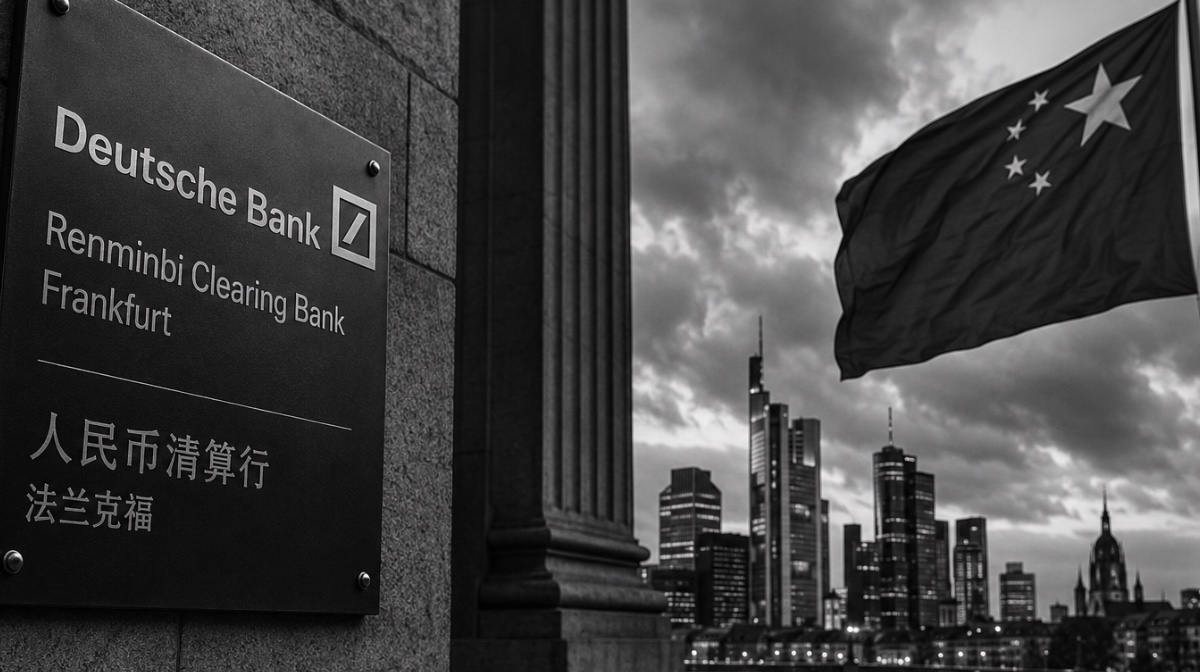
On Monday, the People's Bank of China handed one of the more closely guarded functions in its financial system to a foreign institution for the first time, appointing Deutsche Bank as an official clearing bank for the renminbi in Europe.
The designation, announced by the bank on August 10 following a memorandum of understanding with China's central bank, makes the Frankfurt-based lender the first non-Chinese institution anywhere to hold a role that Beijing has, since the renminbi began traveling abroad in earnest, entrusted exclusively to the overseas branches of its own state-owned banks. Reuters described the appointment as a first for a European lender.
The mechanics sound dry. A clearing bank sits between foreign companies and China's domestic payment rails, settling renminbi transactions for institutions that lack direct access to the mainland's financial system. Deutsche Bank said the mandate allows it to provide direct end-to-end processing, clearing and settlement for cross-border renminbi transactions on behalf of European financial institutions and businesses, acting, in the bank's words, as a local bridge to China's payment systems.
The symbolism is anything but dry. For Beijing, placing a Western systemically important bank; the world's largest euro clearing institution; at the center of its currency's European circulation is a calculated bet that the renminbi internationalizes faster when foreign banks profit from its spread. For Deutsche Bank, it is the payoff on a decade of patient accumulation in a market most Western rivals have approached with growing caution.
And for the global monetary order, it is a data point in the most consequential slow-motion story in finance: whether the dollar's seven-decade dominance is eroding, and what, if anything, is replacing it.
The answer the numbers give is unfashionable but clear. The renminbi is becoming a serious currency for trade and settlement. It is not, on any current evidence, becoming a rival reserve currency. And the institution quietly winning the diversification trade is not a currency at all. It is gold.
The Plumbing of Money
Currency dominance is built on infrastructure as much as trust, and the infrastructure of the renminbi's international life has been, until this week, an almost entirely Chinese affair.
Frankfurt has hosted a renminbi clearing bank since June 2014, when the Bank of China's local branch became the first in the euro area. Industrial and Commercial Bank of China performs the function in Frankfurt as well; China Construction Bank does so in Zurich. Every one of them is a state-owned Chinese institution. Deutsche Bank's appointment does not displace the incumbents; it deepens Frankfurt as a renminbi hub while ending the Chinese state's monopoly on the clearing function in Europe.
Behind the clearing banks sits a larger piece of plumbing: the Cross-Border Interbank Payment System, or CIPS, Beijing's answer to the dollar-centric messaging and settlement networks that route most of the world's money. Launched in October 2015, CIPS processed roughly 180 trillion renminbi, about $25.5 trillion, across 8.44 million transactions in 2025, according to system data, after growing 43 percent by value in 2024. By the end of the first quarter of 2026 it counted 194 direct and 1,597 indirect participants; a mid-July listing on the system's site showed 210 direct and 1,619 indirect.
The direction of travel matters more than the totals. In June 2025, CIPS admitted its first foreign banks as direct participants, a group spanning the Middle East, Africa, Central Asia and Southeast Asia that included Standard Bank, the African Export-Import Bank, First Abu Dhabi Bank, United Overseas Bank and Bangkok Bank, and launched an international renminbi letter-of-credit service. Deutsche Bank has been inside the system far longer: it was one of 19 first-batch direct participants at the 2015 launch.
A methodological dispute shadows every statistic in this story. SWIFT's tracker, the standard measure of global payment shares, understates renminbi usage because payments routed through CIPS's own messaging channel bypass SWIFT entirely; economists at the Council on Foreign Relations, among others, have pressed the point. The caveat has a caveat: CIPS still relies on SWIFT messaging for a reported 80 percent of its traffic, which bounds the understatement and, as several analysts note, means China's alternative rails are not yet insulated from the network they were built to route around.
A Decade of Patient Positioning
Deutsche Bank did not stumble into Monday's appointment. It built toward it through the least glamorous corners of Chinese finance.
The bank was the first German financial institution to issue panda bonds, the onshore renminbi debt sold by foreign borrowers in China's domestic market. It registered an 8 billion renminbi program in 2022, the year of its 150th anniversary in China, and completed four issuances across 2023 and 2024. This year the program accelerated: a record 5.5 billion renminbi issue in March, which the bank said was the largest ever by a foreign bank, drew 8.66 billion renminbi in orders and priced its three-year tranche at 1.95 percent; a 3.5 billion renminbi follow-on in June printed the lowest coupons on record for a foreign panda issuer outside quasi-sovereigns, 21 basis points inside the March levels.
The underwriting franchise runs alongside the issuance one. In 2026, Deutsche Bank has led 3 billion renminbi panda deals apiece for Henkel, Volkswagen and Mercedes-Benz; German industry has become one of the market's most active issuer bases, with BMW, BASF and Bayer also among the borrowers. By the bank's own account, citing WIND and NAFMII data, it has ranked as the top foreign underwriter of onshore registered bonds and of panda bonds for six consecutive years. Those league-table claims are self-reported and should be read as such.
The offshore leg has grown as fast. Deutsche Bank Research estimated that issuance of dim sum bonds, renminbi debt sold outside the mainland, tripled between 2022 and 2024 to 1.4 trillion yuan, roughly $196.5 billion, and projected the market could reach 1.6 trillion yuan in 2026. The bank's analysts noted that some issuers could save up to 40 basis points by raising offshore yuan and swapping the proceeds into dollars; an arbitrage that says as much about the state of dollar funding as about renminbi demand.
"Securing RMB clearing capability in Europe reinforces our role as a trusted global clearing partner and our long-standing support for RMB internationalization," Alexander von zur Muehlen, the bank's chief executive for Asia-Pacific, Europe, the Middle East, Africa and Germany, said in Monday's announcement. Leo Yin, president of Deutsche Bank China, pointed to the bank's presence across the offshore renminbi centers of Frankfurt, London, Singapore and Hong Kong.
Both statements come from an interested party celebrating its own mandate. The independent read, offered by analysts in the appointment's first coverage, was cooler: a prestige win for Deutsche Bank, another piece of the internationalization puzzle for China, and a reminder that persuading the world to use a currency is easier than persuading it to hold one.
What the Numbers Say
Strip away the announcements and the renminbi's global position resolves into a consistent shape: strong and rising in the functions tied to China's trade, marginal in the functions tied to trust.
Start with payments. SWIFT's Global Currency Tracker, renamed from the RMB Tracker in February 2026, put the renminbi at 3.10 percent of global payments by value in its July 2026 edition, covering June data, ranking it fifth, narrowly ahead of the yen. The share has oscillated through the year; December 2025 data showed 2.73 percent and a sixth-place rank. The dollar's share in the same June reading: 50.10 percent. The euro's: 21.88 percent.
Trade finance is the renminbi's strongest suit, at roughly 8 percent of the market in the June 2026 data, second only to the dollar's approximately 81 percent. The pattern fits the underlying economy: China is the world's largest goods trader, and Beijing has spent a decade making it cheaper and easier for that trade to invoice in its own currency. By early 2026, roughly 30 percent of China's own cross-border trade settled in renminbi, up from about 10 percent in 2017, according to analysis published by Forbes contributor Zennon Kapron in February; other estimates put the merchandise-trade share near 40 percent by late 2024.
Foreign exchange tells a similar story of real but bounded progress. The Bank for International Settlements' 2025 triennial survey, conducted in April and published on September 30, 2025, found the renminbi on one side of 8.8 percent of a global market that turned over $9.5 trillion a day, up from 7.0 percent in 2022 and enough for fifth place among all currencies. The dollar was on one side of 89 percent of all trades. That figure did not fall between surveys. It rose, from 88 percent.
Then comes the number that ends most arguments. The International Monetary Fund's official reserve data for the first quarter of 2026 records the renminbi at 1.99 percent of disclosed global foreign-exchange reserves. The dollar: 57.13 percent. The renminbi's share has barely moved in five years, and the IMF itself cautions that recent quarterly shifts in reserve shares owe much to exchange-rate valuation effects rather than active reallocation. The dollar's share has declined, meaningfully, from above 70 percent at the turn of the century; almost none of that decline has gone to China's currency.
The explanation is structural, and it is the consensus of nearly every serious study of the question. China maintains a closed capital account and extensive capital controls. Its bond markets, though vast, are shallower and less transparent than Treasuries. Foreign officials weighing where to park national savings must price in legal and geopolitical risk that has no analogue in dollar or euro assets. The economist Barry Eichengreen, writing in the Financial Times in March 2025, made the canonical case that the dollar remains entrenched for want of a viable full alternative. Until Beijing is willing to let money leave China as freely as it arrives, the renminbi can be a currency companies use. It cannot be a currency central banks trust at scale.
The Dollar's Difficult Year
None of which means the dollar's position is what it was.
The currency fell in 2025 by an amount its own chroniclers found startling. George Saravelos, Deutsche Bank's global head of foreign-exchange research and among the most prominent Wall Street voices on the theme, told Bloomberg early this year that 2025 marked the second-largest annual dollar decline since the era of floating exchange rates began after Bretton Woods. In April 2025, at the height of that year's tariff shock, he had gone further, writing to clients that markets were rapidly de-dollarizing and describing a simultaneous slide in American equities, the dollar and Treasuries that put the currency's safe-haven status in question.
That was one bank's assessment, made in the heat of a market event, and it is worth noting the institutional irony: the loudest de-dollarization desk on Wall Street sits inside the bank that just became Beijing's European clearing agent. But the forces Saravelos identified are documented. Washington's tariff regime has pushed trading partners to reduce dollar exposure at the margin; sanctions have taught Moscow, and any government watching Moscow, that dollar reserves are contingent assets; more than 90 percent of the roughly $245 billion in annual China-Russia trade now settles in national currencies, according to figures cited in the February Forbes analysis, up from near zero before 2022. The Federal Reserve's rate cuts have narrowed the yield advantage that supported the currency, and the contentious leadership transition that seated Chair Kevin Warsh in May, on the narrowest confirmation vote in the institution's history, kept questions about the central bank's independence in market commentary throughout.
Yet the same period produced the strongest new argument for dollar persistence. The GENIUS Act, signed on July 18, 2025, gave the United States its first federal framework for stablecoins and required that they be backed by dollars and short-term Treasuries. Roughly 99 percent of the stablecoin market is dollar-denominated, according to JPMorgan research; the European Central Bank and the Bank for International Settlements have both described the phenomenon as a form of stealth dollarization, since the dollar's share of stablecoins exceeds its share of conventional payments. Standard Chartered analysts reaffirmed a forecast of a $2 trillion stablecoin market by the end of 2028 in a February report, while trimming their estimate of the associated Treasury-bill demand to between $800 billion and $1 trillion. Skeptics, including legal scholars writing for Duke's financial-regulation blog, call the dollar-defense rationale for stablecoin law overstated. Even discounted, the direction is notable: the newest payment technology in global finance is extending the oldest hegemony.
The Quiet Winner
If reserve managers are not buying renminbi with the dollars they shed, what are they buying? The European Central Bank has answered the question twice, and the answer both times was bullion.
The ECB's June 2025 review of the euro's international role found that gold had risen to roughly 20 percent of global official reserve assets by the end of 2024, overtaking the euro's 16 percent to become the second-largest reserve asset behind the dollar. A subsequent ECB assessment put gold near 27 percent of reserve assets at the end of 2025, ahead of U.S. Treasuries at 22 percent. Central banks bought 863.3 tonnes of gold in 2025, the World Gold Council reported in its full-year demand review; below the extraordinary 1,000-tonne pace of 2022 through 2024, but nearly double the average of the 2010s.
Gold requires no trust in any government, settles no invoices and pays no interest. Its ascent is the clearest available evidence of what diversification away from the dollar actually looks like in practice: not a migration to a rival currency, but a retreat from currencies altogether at the margin. The renminbi's architects can take limited comfort from a trend whose chief beneficiary sits in vaults.
The Stakes for Berlin and Beijing
The choice of a German bank, and a German city, was not incidental.
China was again Germany's largest trading partner in 2025, with two-way goods trade of €251.8 billion, according to the federal statistics office, edging past the United States at €240.5 billion. German multinationals are the natural first customers for renminbi invoicing, renminbi financing and now renminbi clearing through a hometown institution; the same Volkswagen and Mercedes-Benz that Deutsche Bank took to the panda market are the corporates whose treasury flows a Frankfurt clearing bank exists to serve.
Each party's incentives are legible. Beijing wants the renminbi's spread to be profitable for Western finance, because infrastructure adopted by self-interest outlasts infrastructure imposed by policy; the People's Bank has spent 2025 and 2026 layering on supporting measures, from Governor Pan Gongsheng's eight-point Shanghai package announced at the Lujiazui Forum in June 2025 to a digital-renminbi international operations center opened that September, alongside a swap-line network exceeding 4.3 trillion renminbi across more than 40 central banks. Deutsche Bank wants fee income and strategic indispensability in the one major market where its scale in euro clearing translates into a franchise its American rivals cannot easily replicate; U.S. banks face political constraints in seeking such a role that a Frankfurt institution does not, or not yet. Washington has said nothing official about the appointment; the durable American interest is less in blocking renminbi trade settlement, which is largely beyond reach, than in preserving the reserve and funding dominance that the data suggest is not currently threatened.
The competitive field is already moving. HSBC and Standard Chartered run the dominant offshore renminbi franchises and have long histories inside CIPS; Standard Chartered publishes its own index of renminbi globalization. The question Deutsche Bank's appointment raises for every one of them is whether Beijing intends the Frankfurt mandate as a singular gesture or a template.
What Comes Next
- Clearing volumes. Neither the PBOC nor Deutsche Bank has disclosed expected flows through the new Frankfurt operation. The first disclosures, or their absence, will show whether the mandate is plumbing or press release.
- A second foreign appointment. If Beijing extends clearing-bank status to another Western institution, in London, Paris or Singapore, the Deutsche Bank designation becomes a policy, not an exception.
- The reserve threshold. The renminbi's share of IMF-tracked reserves has been pinned near 2 percent for years. A decisive move above 3 percent would be the first hard evidence that settlement usage is converting into reserve trust. Nothing in the Q1 2026 data suggests it is imminent.
- CIPS and SWIFT. The share of CIPS traffic carried on its own messaging channel, rather than SWIFT's, is the single best indicator of whether China's rails are becoming genuinely independent.
- The oil test. The yuan's share of global oil payments remained below 5 percent as of mid-2025, and Saudi Arabia, though publicly open to yuan pricing, still invoices the bulk of its crude in dollars. A large-scale Gulf commitment to yuan invoicing would change this story's trajectory more than any clearing appointment.
- Capital-account signals. Any concrete step toward renminbi convertibility would outweigh every other item on this list. None is currently scheduled.
The likeliest path is the one already visible: a world in which the renminbi keeps winning share in the invoicing and settlement of trade that touches China, the dollar keeps its grip on reserves, funding and foreign exchange, and central banks keep buying gold against the uncertainty of both. Deutsche Bank has now positioned itself to earn fees on those flows whichever way they run. That may be the most honest summary of Monday's announcement: not a bet on the renminbi against the dollar, but a bet that the rewiring itself, slow, partial and profitable, is the trade.