Boston Dynamics IPO slips as Atlas factory scale-up drags
Boston Dynamics IPO prospects have cooled as Hyundai waits for Atlas deployments to scale and losses continue at the robotics unit.
Atlas Newsdesk ·
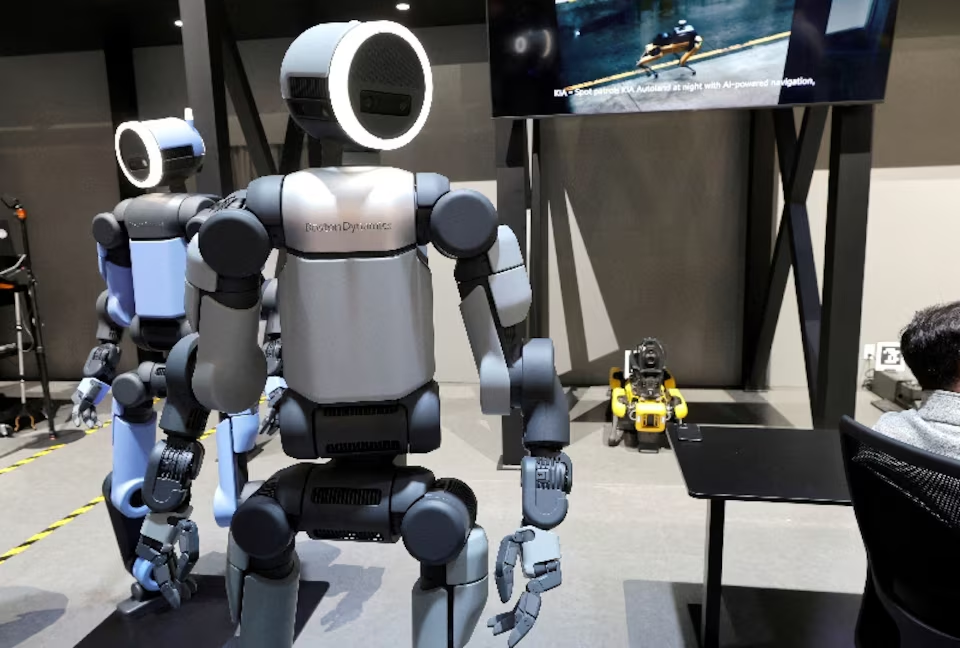
Boston Dynamics IPO hopes have cooled as Hyundai waits for Atlas robots to scale, with the unit still losing money after five years.
A senior executive at Hyundai Motor Group with direct knowledge of the matter said a listing next year was unlikely, citing the absence of large-scale Atlas deployments and the company’s lack of profitability. The person requested anonymity because the discussions are confidential.
Hyundai has not announced a listing schedule or valuation goal for Boston Dynamics, and the group did not immediately respond to a request for comment. Boston Dynamics was not available for comment outside business hours.
Atlas scale comes first
The executive’s caution follows months of investor interest in Hyundai’s robotics strategy after the company showed an updated Atlas robot in January at the Consumer Electronics Show in Las Vegas. Hyundai Motor shares more than doubled earlier this year following the event, reaching record highs before giving back much of the advance as updates on the robotics plan remained limited.
When asked whether a 2027 initial public offering was possible, the executive said, "It won’t be easy." The executive added, "We need to see conditions and situations," without giving a more detailed timeline.
Hyundai took control of Boston Dynamics in 2021 and said in July it would acquire SoftBank’s roughly 10% stake, making the robotics company a wholly owned subsidiary. Hyundai did not disclose the price; reports at the time put the transaction near 500 billion won, equivalent to about $371.51 million at the stated exchange rate of 1,345.8500 won per dollar.
Losses frame valuation gap
The financial record gives investors a harder anchor than the robot demonstrations. Boston Dynamics posted a 528.4 billion won loss in 2025, according to a Hyundai Glovis filing; cumulative losses from 2021 through 2025 totaled nearly 1.7 trillion won.
Valuation estimates remain wide. Samsung Securities said market estimates place Boston Dynamics between 50 trillion won and 100 trillion won, while IBK Securities said in August that the company could be valued at 141 trillion won by 2030 if revenue reaches about 11 trillion won that year.
Those figures depend on a commercial step that humanoid robotics companies have not yet proved at scale: reliable use inside factories. Hyundai has said it wants a plant capable of producing 30,000 robots a year by 2028, with humanoid robots first deployed at its Georgia factory that year before wider use across its manufacturing network.
Factory work tests humanoids
Kim Hyun-su, a senior fund manager at Seoul-based IBK Asset Management, said factory use would take longer than investor enthusiasm suggests. "It’s not difficult to make robots dancing, but it’s challenging to make them carry heavy loads and get involved in manufacturing at plants," he said.
Tesla CEO Elon Musk has made a similar point about the difficulty of scaling humanoid robots, describing Optimus as "the hardest product to scale manufacturing" that the electric car maker has made. The comparison matters because both Tesla and Hyundai are trying to move humanoids from demonstration videos into repetitive industrial tasks where downtime, safety and payload capacity determine commercial value.
Kim Joon-sung, an analyst at Meritz Securities, said a Boston Dynamics listing was more likely in 2029 or 2030. In his view, Hyundai first needs operational data from internal deployments and further improvements in robot capability before selling Atlas broadly to outside customers.
Deployment data sets the path
If Hyundai meets the 2028 production and Georgia deployment targets, Boston Dynamics would have a clearer case for a later listing: factory data could support revenue forecasts, improve valuation confidence and help the wider robotics sector argue that humanoids are moving into industrial budgets. At the macro level, that path would feed into automation spending rather than near-term labor replacement across manufacturing.
If deployments slip or losses remain close to the 2025 level, an offering could move farther into the next decade. That would keep Boston Dynamics dependent on Hyundai capital, slow external customer expansion and leave investors valuing humanoid robotics more on prototypes than operating results.