Boeing Q1 loss narrows as 737 MAX output set to rise
Boeing’s Q1 2024 loss narrowed to $7 million as revenue rose to $22.2 billion; it plans a 737 MAX output increase pending FAA approval.
Atlas Newsdesk ·
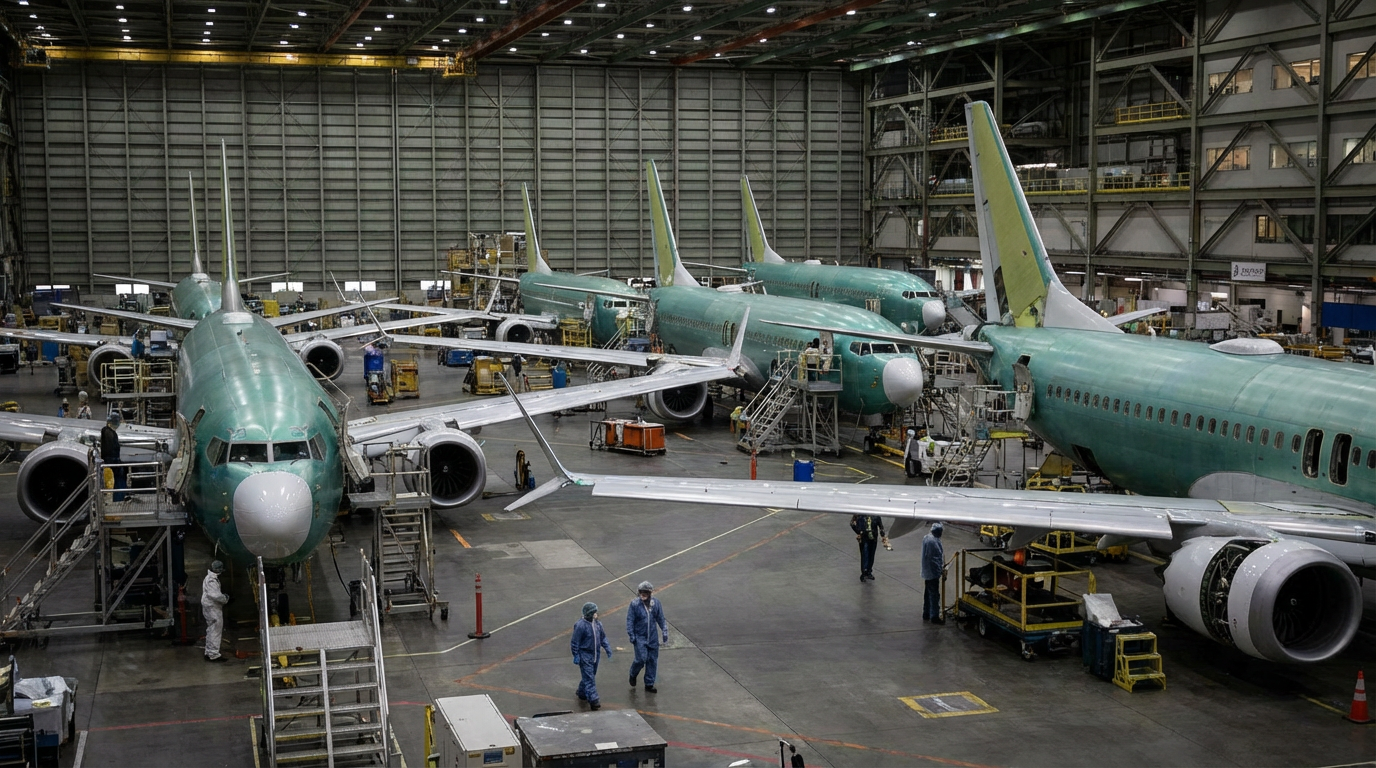
What happened: Boeing Co. reported a net loss of $7 million for the first quarter of 2024, narrowing from a $31 million loss in the same quarter a year earlier. The company said it used $1.5 billion in cash from January through March, an improvement from $2.3 billion in the prior-year period. Revenue rose 14% year-over-year to $22.2 billion, and Boeing linked the stronger results to better performance in commercial airplane production.
Boeing also outlined a near-term manufacturing step for its most important narrowbody program. The company said it plans to lift the 737 MAX production rate to 47 aircraft per month from 42 this summer, contingent on Federal Aviation Administration (FAA) approval. Boeing framed the planned increase in the context of a January 2024 incident involving an Alaska Airlines 737 MAX, which it said had temporarily affected the production cadence.
Across the business, Boeing reported revenue growth in each of its three divisions during the quarter. Commercial Airplanes revenue increased 13% to $9.2 billion. Defense, Space & Security revenue rose 21% to $7.6 billion, while Global Services revenue grew 6% to $5.4 billion.
Deliveries also moved higher, a key operational metric closely watched by airlines, suppliers, and investors because it influences cash generation and customer capacity plans. Boeing said it delivered 143 commercial airplanes in Q1 2024, up 10% from 130 in Q1 2023. The company attributed the quarter’s improved financial performance to enhanced commercial airplane production, aligning with the delivery increase.
What it means: The combination of a smaller loss, reduced cash consumption, and higher revenue underscores how production and delivery execution remains central to Boeing’s near-term financial trajectory. For airlines and leasing firms, Boeing’s stated plan to raise 737 MAX output—subject to FAA approval—matters because it can shape fleet planning and aircraft availability, particularly for carriers relying on narrowbody capacity.
For global markets and supply chains, the planned move from 42 to 47 aircraft per month signals potential changes in demand for components and labor across Boeing’s manufacturing ecosystem, while the FAA approval requirement highlights ongoing regulatory sensitivity after the January 2024 Alaska Airlines 737 MAX incident. Separately, Boeing provided a longer-dated program timeline, saying it expects certification of the 737 MAX 7 and MAX 10 in 2026, with first deliveries anticipated in 2027.
Risks and unknowns: Boeing’s production-rate plan is explicitly tied to FAA approval, and the timing of that approval remains a key variable. The company’s certification and delivery expectations for the MAX 7 and MAX 10 are also forward-looking milestones that will depend on the certification process and execution against the stated schedule.