Bezos Expands AI Focus From Cloud to Physical Systems
Jeff Bezos launches $100B AI fund, Project Prometheus, to embed advanced AI into manufacturing by acquiring companies, revolutionizing production.
Jason Kwon ·
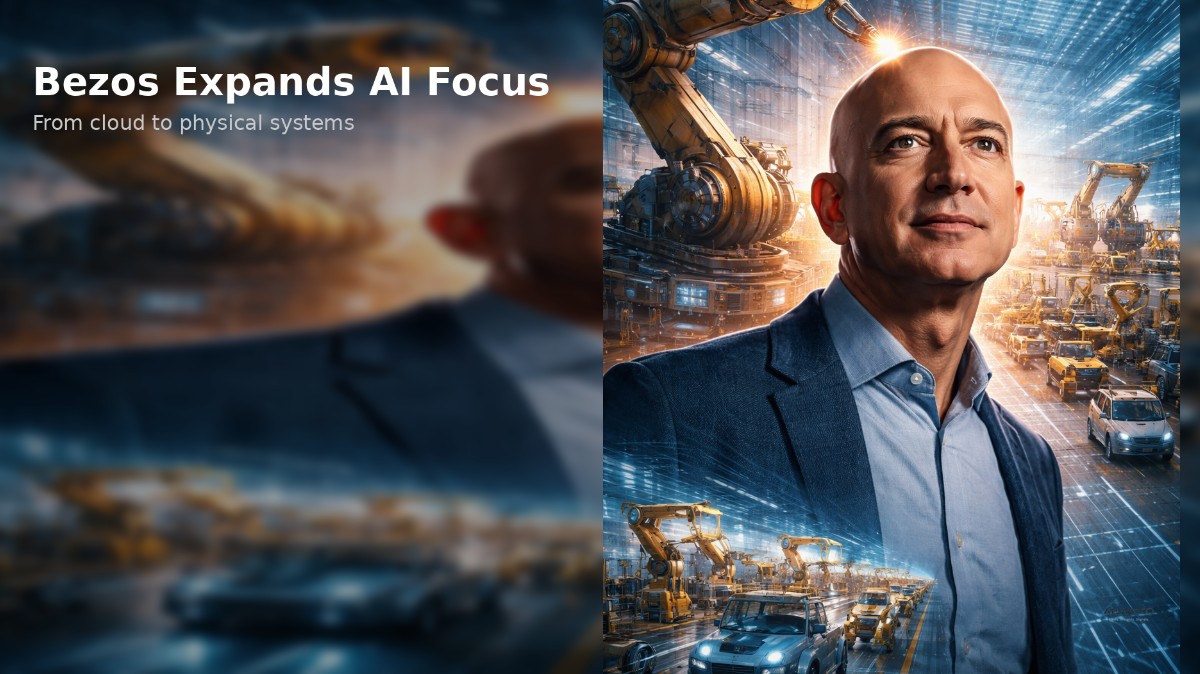
Jeff Bezos is making one of his biggest bets since building Amazon’s cloud empire—and this time, it’s not about software.
The Amazon.com Inc. founder is in early talks to raise as much as $100 billion for a new investment vehicle aimed at transforming manufacturing through artificial intelligence. But beneath the scale of the fundraising effort lies a more consequential shift: Bezos is aligning himself with a different vision of how AI evolves—and where the real economic value will be created.
The Cloud-First Era and Beyond
For the past decade, Amazon helped define the “cloud-first” era. Amazon Web Services turned computing into a utility and became one of the company’s most profitable divisions. Today, much of the AI boom—led by OpenAI, Anthropic, and Google—still runs on that infrastructure, with large language models automating tasks across coding, finance, and customer service. Bezos’ new move suggests the next phase of AI may not be built in the cloud alone.
Project Prometheus and World Models
At the center of the strategy is Project Prometheus , a startup developing AI systems that simulate real-world physics—often referred to as “world models.” Bezos recently stepped in as co-chief executive officer, a rare return to an operating role that signals more than passive interest. It puts him directly in the middle of a growing debate inside the AI industry: whether intelligence built on language alone is enough.
World models aim to go further. Instead of predicting text, they attempt to predict reality—how machines behave, how materials fail, how environments evolve. The goal is to make AI systems capable of operating in factories, supply chains, and eventually robotics.
That vision fits squarely within Amazon’s DNA.
Amazon's Physical Network
Over the past two decades, Amazon has quietly built one of the world’s most sophisticated physical networks: hundreds of fulfillment centers, sprawling logistics operations, and an increasingly automated warehouse system. The company has deployed more than 750,000 robots across its facilities and is steadily increasing automation to improve speed and reduce costs. In some warehouses, robots already rival human workers in number.
The new fund would extend that model beyond Amazon itself—acquiring industrial companies and embedding AI directly into their operations. It’s a familiar playbook: control the infrastructure, layer software intelligence on top, and capture efficiency gains at scale.
Fundraising and Global Ambition
The fundraising trail also offers clues about the ambition. Bezos has recently traveled to the Middle East and Singapore to meet with sovereign wealth funds and institutional investors—two regions that have become central to large-scale technology financing. Gulf funds, flush with energy revenues, have been aggressively deploying capital into AI, semiconductors, and infrastructure. Singapore, meanwhile, has positioned itself as a key hub for advanced manufacturing and deep-tech investment in Asia.
These investors are not just writing checks—they are looking for long-term exposure to the physical transformation of industries, from defense to chipmaking. That aligns with the fund’s target sectors and its capital-intensive approach.
The effort would rival SoftBank Group Corp.’s $100 billion Vision Fund , but with a more industrial focus. Separately, Prometheus is in talks to raise up to $6 billion , after securing $6.2 billion last year. JPMorgan Chase & Co. has also held preliminary discussions about backing the initiative through its $10 billion security and resiliency program.
Criticism and Economic Impact
Not everyone is convinced the shift will be painless. Sen. Bernie Sanders sharply criticized the move, writing on X that Bezos—“worth $234 billion”—is aiming to replace hundreds of thousands of workers with automation and expand that model globally. Sanders framed the effort as part of a broader conflict between capital and labor, accusing “oligarchs” of waging a “war against workers.”
https://x.com/BernieSanders/status/2034722382921728422?s=20
The political reaction underscores a reality already playing out. AI-driven automation has begun reshaping white-collar industries, with layoffs tied to efficiency gains from language models. Manufacturing, historically slower to adopt such changes, could face a more disruptive wave if AI systems begin to handle physical tasks at scale.
Still, economists remain divided. Some argue automation will drive productivity and create new categories of work, while others warn of structural displacement in both blue- and white-collar sectors.
The Future of AI Intelligence
Inside the AI industry, the bigger question is more technical—and unresolved.
Can large language models, trained on vast amounts of text and code, eventually approximate general intelligence? Or does true intelligence require systems that understand the physical world?
Companies like OpenAI and Google continue to scale LLMs, betting that reasoning will emerge from size and data. Bezos, along with figures like Elon Musk—who is pushing humanoid robotics through Tesla—and Travis Kalanick, now focused on AI-driven manufacturing, appears to be leaning toward a different conclusion.
That intelligence needs to be grounded in reality.
If that view proves correct, the next generation of AI leaders may not look like software companies at all. They may look more like industrial platforms—combining data, machines, and capital at a massive scale.
Bezos has spent much of his career building exactly that kind of system. Now, he’s betting it’s the key to what comes next.