BCI vendors face margin shift as bioRxiv preprint claims processed EEG‑gaze data matters
A new bioRxiv preprint details a method fusing EEG and eye-tracking to disentangle neural signals, potentially transforming BCI development and value.
Edward Mullen ·
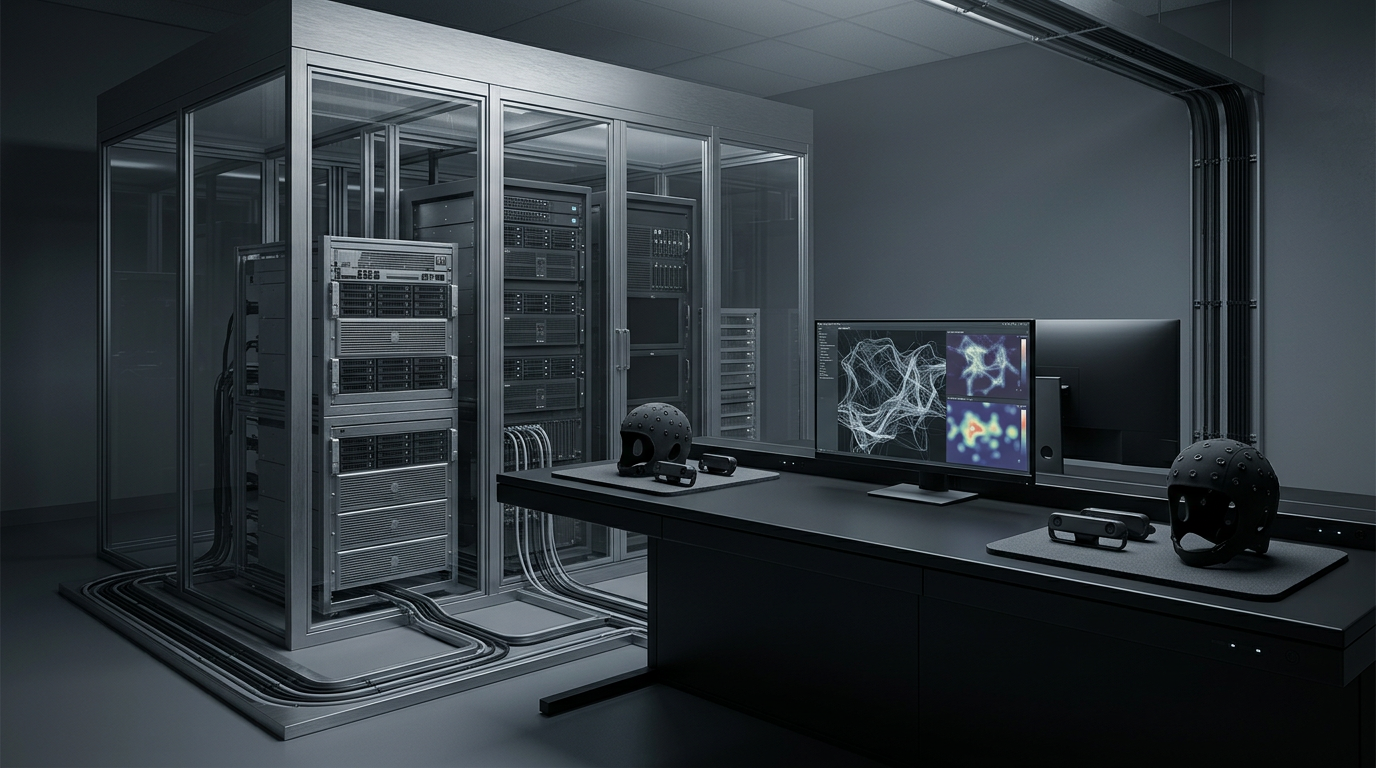
The prevailing wisdom in BCI development centers on optimizing sensor hardware and applying ever more powerful general-purpose digital signal processing. This view, however, misses the critical shift occurring within data processing itself. The next frontier of BCI margin will not be found in cleaner raw signals, but in proprietary, highly integrated spatiotemporal neural pattern datasets derived from advanced deconvolution methods for EEG and eye-tracking.
Why a deconvolution paper is really a data business story
What the paper actually does — and does not — say According to the bioRxiv preprint, the method jointly models EEG and eye movements and uses deconvolution to separate neural events that would otherwise blur together in real-world behavior. The authors describe validation in a hybrid search condition that blends visual scan and memory retrieval, a setup closer to how workers actually operate than tightly controlled, single-stimulus trials.
That’s meaningful for applied BCI: if your target workflows involve attention shifts, reading, and mixed recall, overlapping signals are the rule, not the exception. However, as a v1 preprint, it does not present independent replication, and it does not specify commercial performance constraints such as real-time throughput, compute budget, or robustness across different task domains beyond the reported hybrid search.
Those omissions matter if you plan to ship closed-loop systems where latency and generalization control pricing power.
The 2026 myth: better sensors and generic DSP are enough
The 50% story you don’t hear: ownership of processed patterns Limits, baselines, and the missing compute line item Skeptic’s read: is this just fancy preprocessing A fair counterpoint is that hybrid search is a convenient demo and that cheaper, simpler pipelines may match performance once sensors improve and tasks are better constrained. If that holds, the commercial edge reverts to hardware makers and general-purpose DSP providers, and deconvolution becomes a niche tool rather than a margin engine.
The preprint doesn’t resolve this; it introduces a promising method and validates it on a specific task class. The only way to settle the argument is head-to-head baselines across tasks with transparent cost and latency reporting.
Until then, treat the margin-shift thesis as a live bet, not a conclusion.
What changes for buyers and builders over the next year
The signals that will prove this right—or wrong—by year-end The preprint’s core claim is methodological, not a gadget: a “novel deconvolution-based method that integrates concurrent EEG and eye-tracking data to disentangle overlapping neural signals during complex visual search tasks,” validated on a “hybrid visual and memory search.” That is a shift from cleaning signals to constructing labeled, time-aligned brain–eye patterns tied to specific task demands. If that workflow generalizes, the asset to license or protect won’t be the filter—it will be the resulting library of patterns by task, cohort, and context.
In other words, the margin migrates to who owns the sequence-level, task-grounded representations, not who shipped the sensor or the generic denoiser.
The dominant read in vendor decks is that more electrodes, faster sampling, and heavier compute will unlock the next tier of BCI capability. That view underestimates the combinatorial mess of natural behavior.
In tasks like the paper’s hybrid search, the hard part is not extracting one clean signal; it’s attributing overlapping events to distinct cognitive operations with timing precise enough to act on. The preprint’s deconvolution framing is a reminder that the economically scarce thing is not raw data or a general-purpose algorithm—it is the processed, task-indexed pattern with provenance.
That is what can be versioned, QA’d, and sold.
The preprint focuses on method and validation; it is silent on commercial posture. In practice, if your product depends on integrated EEG–gaze deconvolution, your defensibility will hinge on who owns the processed outputs and the training corpora that generated them.
If those pattern libraries are built from paid cohorts and workplace recordings, licensing, consent, and derivative-use rights quickly overshadow sensor BOM and generic DSP licensing. Expect negotiations to specify access to processed spatiotemporal signatures by task family, rather than unlimited access to raw streams.
That procurement shift changes who captures the margin: integrators with proprietary pattern libraries outperform commodity hardware assemblers.
Because this is a preprint, the claims are preliminary. Executives should care about three missing dials that determine cost-per-task.
First, baseline comparisons: it matters whether gains over simpler preprocessing persist across tasks, users, and environments or whether improvements collapse outside the hybrid search window. Second, reproducibility edges: the method’s dependence on concurrent eye tracking may limit applicability in settings where gaze capture is degraded or disallowed, and the preprint does not map that boundary.
Third, runtime budget: the paper does not state the computational resources required to run deconvolution in real-time product loops, which determines whether the method is viable on-device or demands cloud latency—and therefore whether the margin you protect lives in a licensed dataset or a service contract. None of these are fatal omissions for a first paper, but they are the difference between a publishable technique and a sellable capability.
If this line of work holds up, R&D roadmaps shift. Builders prioritize collecting synchronized EEG–gaze datasets under task paradigms that mirror knowledge work (reading, triage, audit, supervision) and invest in deconvolution pipelines that bake task labels directly into the time series.
Buyers start asking for processed, task-indexed signature libraries in proofs-of-concept, not just sensor specs. Meanwhile, data-rights diligence moves upstream: consent language for integrated streams and downstream derivative rights around spatiotemporal signatures become standard terms.
None of this requires waiting for general AI; it is a data-engineering and licensing problem framed by a neuroscience method.
Watch for whether vendor messaging and RFPs change. If press releases and product pages begin highlighting “EEG–gaze deconvolution” and “task-indexed spatiotemporal signatures,” the market is moving toward processed data assets.
If grant calls and term sheets emphasize access to combined EEG/eye-tracking cohorts and processed libraries, not just sensor specs, the margin is reassigning. Conversely, if conference papers this fall show that simpler, widely available preprocessing matches or beats deconvolution on comparable tasks—and vendors keep centering hardware gains—the thesis is wrong.
Those are observable shifts executives can track without waiting for multi-year trials.