

Can NASA safely return humans to the Moon after a fifty year hiatus?
NASA Artemis II is scheduled to launch today, sending four astronauts on a 10-day lunar flyby to test Orion systems and re-entry heat limits.
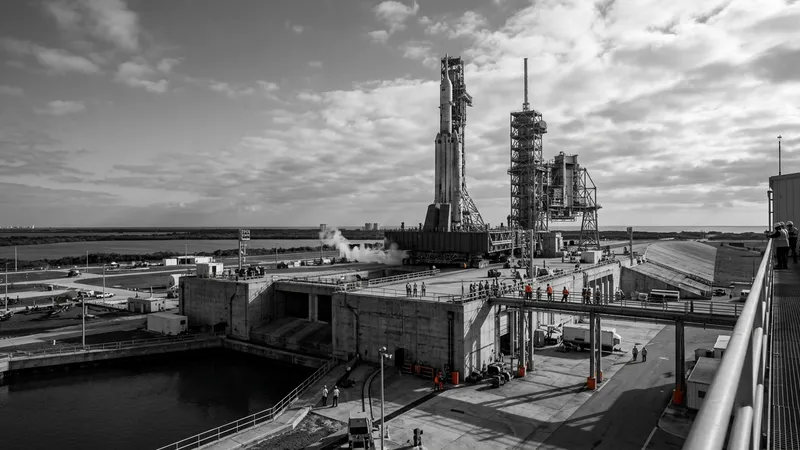
NASA is preparing to launch Artemis II today from Cape Canaveral, Florida, marking the agency’s first crewed lunar mission in more than five decades. The flight will use the Orion capsule and carry four astronauts. Officials have described Artemis II as a central step in the agency’s broader “Moon to Mars” initiative.
The Artemis program is designed to reconnect human spaceflight with operations beyond low Earth orbit, with the Moon positioned as the near-term destination. NASA’s stated objective under “Moon to Mars” is to build a permanent, habitable base on the Moon. The agency has framed that goal as a precursor to future human expeditions to Mars, linking near-term lunar activity with longer-range deep-space ambitions.
Artemis II is planned as a 10-day mission covering 685,000 miles, with the core objective centered on a lunar flyby rather than a landing. NASA intends to use the flight to stress-test Orion’s critical systems in conditions meant to reflect extended spaceflight. That includes evaluating life support performance while continuously tracking astronaut health throughout the mission.
A major engineering focus is whether Orion can safely handle the extreme conditions of atmospheric re-entry after traveling beyond low Earth orbit. NASA has said the capsule must withstand temperatures up to 3,000 degrees Fahrenheit (1650 degrees Celsius) during its return. Confirming that performance is presented as essential for safe recovery following high-speed re-entry.
On flight day six, Orion is scheduled to conduct a slingshot maneuver around the Moon. During that pass, the capsule is expected to fly between 4,000 and 6,000 miles from the lunar surface. NASA has described the maneuver and trajectory as a key opportunity to validate spacecraft performance during a critical phase of the mission.
The lunar flyby is also expected to support imaging objectives, including photographs of the Moon’s south pole. NASA has identified the south pole as a potential landing area for future human missions. Officials have indicated that such use could occur as early as 2028, positioning Artemis II’s observations as part of the agency’s preparation for later crewed operations.
More stories
- Bandai Namco sets 2027 cross-play test for Sparking Zero
- Deadlock’s Solomon hides 8-to-32 chess reload boards
- Nintendo Life polls 673 readers on Ocarina pronunciation
- Bandai Namco says Ace Combat 8 sells over 1 million copies
- Kingdom Hearts holds No. 1 on Switch 2 eShop chart
- Cyberpunk 2077 tops 40m sales as Paramount develops film, Odatv says
- Visa introduces AI tools to automate global credit card dispute resolution systems
- Oracle job cuts hit thousands as AI spending accelerates
- AI was everywhere at gaming’s big developer conference — except the games
- New Apple TV and HomePod Mini Remain 'Ready' to Launch - MacRumors
Latest news
- Washington weighs a harder bargain for Israel’s next defense aid pact
- Turkey-Israel spat puts Washington’s Gaza diplomacy in a tighter corner
- Bangladesh MICS7 shows high lead in 38.5% of children
- Mashreq CEO Abdelaal joins 15-member Swift board
- Sudan strikes kill 112, rights group says
- Ticketory says six-month bookings exceed €550,000
- Merck KGaA tops MediciNova on 8 of 15 metrics
- Tanker burns near Hormuz after munition strike