China’s humanoid robots race toward soldier debate at Games
Humanoid robots at Beijing’s World Games are drawing military scrutiny as more than 2,000 machines compete across athletic events.
Amira Hassan ·
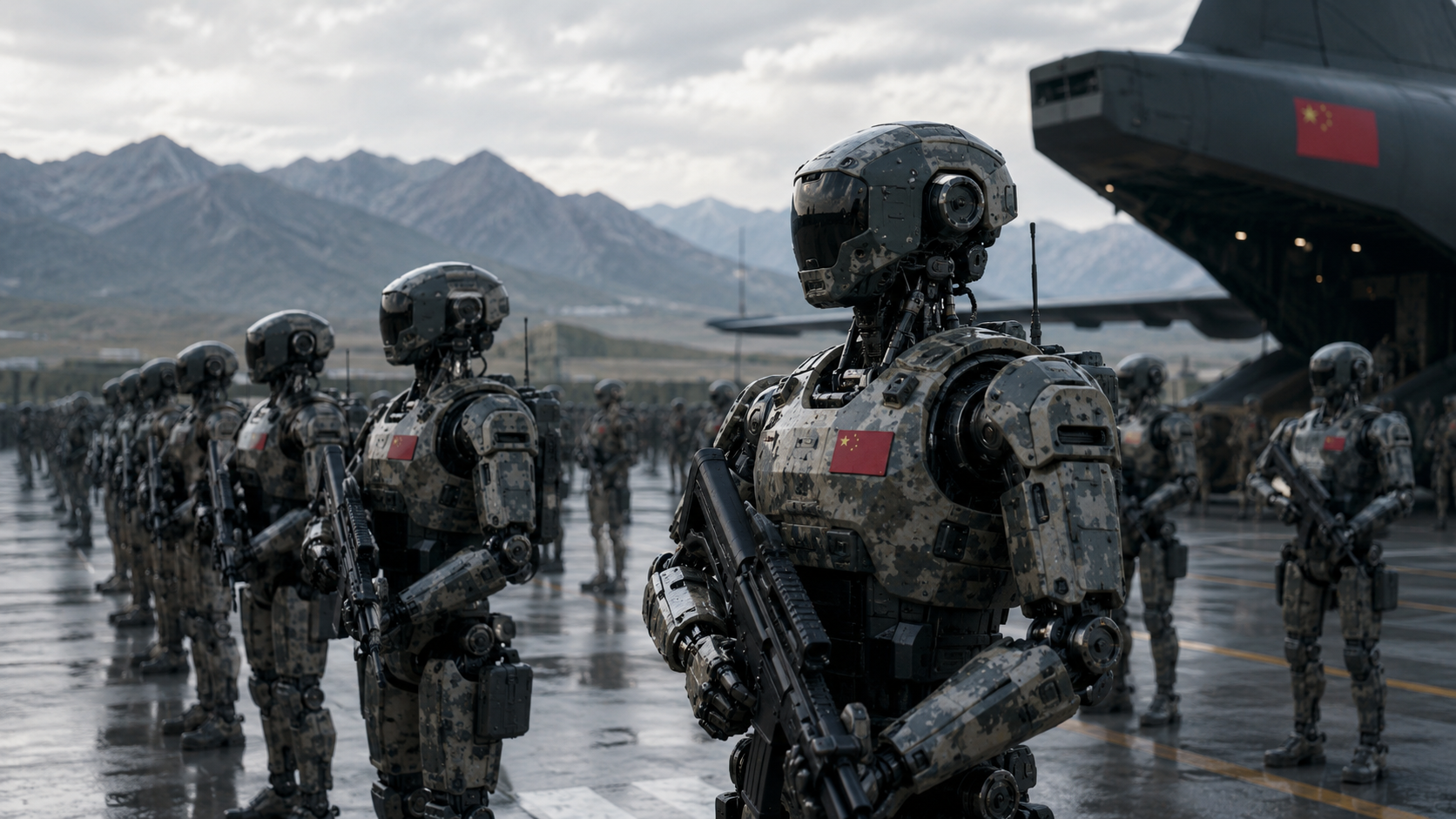
Humanoid robots at Beijing’s World Games are turning sport into a military timeline debate. More than 2,000 machines from 600-plus teams are competing.
Beijing oval becomes test track
The 2026 World Humanoid Robot Games are being held at Beijing’s National Speed Skating Oval, the indoor venue used during the 2022 Winter Olympics. China is hosting the contest for a second straight edition, with teams listed from 16 countries.
The program mixes track events with combat, gymnastics, soccer and obstacle courses, turning familiar sports into public tests of balance, speed and machine recovery. Smaller robots have played on a reduced soccer field, while larger models have boxed, sprinted, climbed and crawled under the supervision of human handlers.
A 9.39-second race
The result drawing the most attention was a reported 100-meter run of 9.39 seconds on Sunday. That was 0.19 seconds faster than Usain Bolt’s 9.58-second world record from 2009, giving the event a comparison point that ordinary spectators could size immediately.
The competition also showed the limits of current machines. Some robots tripped, collapsed, caught fire or hit safety barriers during events, failures that contrasted with the record-setting sprint and underlined how uneven humanoid performance remains outside tightly managed demonstrations.
Those breakdowns matter because the same physical traits being tested in Beijing have potential military applications. Sprinting, lifting, crawling, balance under contact and the ability to recover after a fall are all attributes that could be useful in logistics, reconnaissance or combat support if control systems become dependable.
Five to 10 years
Yang Kun, a robotics engineer at Shanghai-based AG BOT, said robot soldiers are an eventual goal for developers and placed the likely development window at five to 10 years. His estimate points to a near-term debate over control, accountability and deployment rather than a distant science-fiction question.
Yang framed command authority as the core issue, saying, "It all depends on who controls them." That distinction is central: a remote-operated humanoid, an autonomous battlefield system and a civilian rescue robot raise different risks even if they share the same walking frame.
His view is one engineer’s assessment, not an official Chinese military timetable. The main open question is whether companies can make humanoids reliable enough for uncontrolled settings, where dust, weather, debris, communications loss and human movement create harder conditions than an indoor arena.
Three paths for robotics
If hardware gains continue and control systems mature, military interest could feed a wider capital cycle in sensors, batteries, actuators and artificial intelligence software. For AG BOT, that path would make defense-adjacent credibility more valuable; for the sector, it would push suppliers toward ruggedized parts and safety-certified systems.
If accidents keep exposing reliability gaps, adoption would likely stay closer to factories, warehouses, emergency response and entertainment venues. In that case, the global macro effect would be smaller and tied to industrial automation spending, while AG BOT and its peers would face pressure to prove civilian use cases before any armed role.
If governments tighten rules on autonomous weapons or restrict advanced robotics exports, the industry could split around national security lines. AG BOT would be more dependent on domestic buyers and locally sourced components, while the wider humanoid robot sector would face slower cross-border collaboration and a higher cost of compliance.
The Beijing games have therefore become more than a technology showcase. The record times, public failures and five-to-10-year military estimate together place humanoid robots at the edge of a policy argument that will follow the machines well beyond the arena.